


Remote Door Access Management That Scales


A security team gets the alert at 9:12 p.m. A door at a satellite site is propped open, the local manager is offsite, and the credential audit is spread across three different systems. That kind of delay is exactly why remote door access management has become a core requirement for modern facilities, not a nice-to-have feature.
For organizations managing multiple buildings, rotating staff, contractors, vendors, and visitors, physical access can no longer depend on local servers, manual updates, or someone being onsite to make simple changes. The real value of a cloud-based approach is not just opening and closing doors from afar. It is gaining centralized control over identity, events, permissions, and response across every site from one operating environment.
What remote door access management actually changes
At a basic level, remote door access management allows authorized teams to control doors, credentials, schedules, and events from a centralized interface. In practice, the impact is much broader. Security teams can issue or revoke access instantly, facilities managers can monitor door status without walking the site, and IT can support the system without maintaining on-premise access control servers.
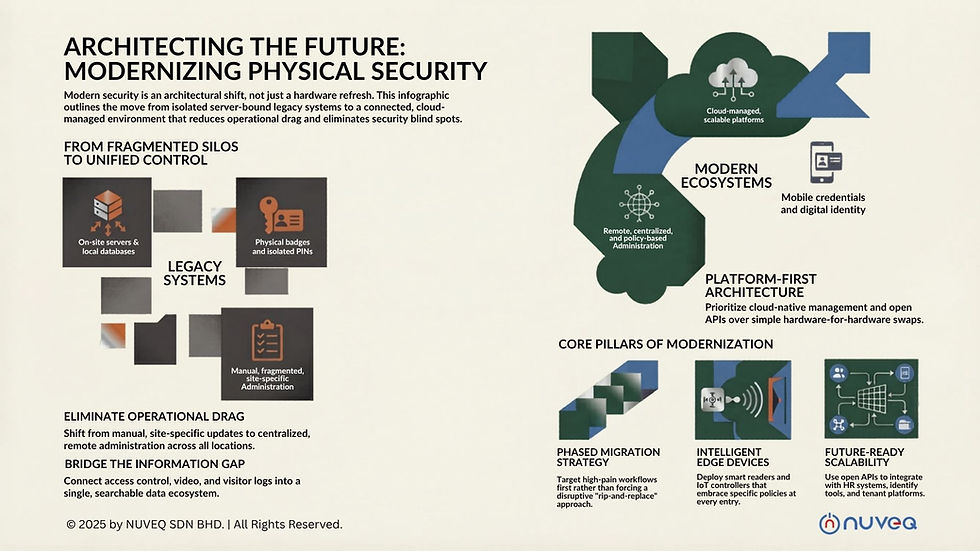
That shift matters because legacy access control was designed around local infrastructure. Each site often had its own software instance, its own database, and its own administrative process. As portfolios grew, security became fragmented. Reporting became slower. Credential management became inconsistent. Troubleshooting became expensive because even small issues required onsite intervention or specialized local support.
A remote model reduces that friction. It brings doors, users, and events into one system so policies can be applied consistently across locations. It also shortens the gap between an event and a response. If a terminated employee still has access, permissions can be removed in real time. If a delivery vendor needs a temporary credential, it can be issued remotely and tied to a defined schedule. If a door controller goes offline, the operations team sees it immediately instead of discovering the issue after a complaint.
Why enterprises are replacing site-by-site access control
The main driver is scale. A single office can tolerate a surprising amount of manual work. A distributed portfolio cannot. Once an organization manages dozens, hundreds, or thousands of doors, small inefficiencies become operational risk.
Security leaders are also under pressure to prove more than perimeter control. They need cleaner audit trails, stronger identity verification, better support for hybrid work, and faster coordination during incidents. A fragmented access system works against all of that. It creates blind spots between buildings, inconsistent user provisioning, and delayed reporting when executives or regulators need answers.
Cloud-native architecture changes the economics as well. When access control depends on on-premise servers, each location adds hardware, maintenance overhead, software updates, backup requirements, and power consumption. Centralized remote administration removes much of that burden. It can also support sustainability goals by reducing reliance on local infrastructure.
That said, cloud-based does not mean one-size-fits-all. Some organizations need a gradual migration because they have legacy hardware in the field. Others need higher-assurance identity workflows because of compliance, critical infrastructure, or regulated environments. The strongest platforms account for those realities with flexible hardware support, open integrations, and role-based administration.
The core capabilities behind effective remote door access management
Not every remote access platform delivers the same operational value. Buyers should look past the dashboard and focus on what the system lets their teams do at scale.
Centralized credential management is one of the most important capabilities. Access rights should be assignable by role, schedule, location, and policy, not just by individual user. That allows HR, security, and operations to align onboarding and offboarding with real facility risk. Mobile credentials are especially useful here because they reduce card distribution delays and support a more controlled digital identity process.
Real-time event visibility is equally important. The platform should surface door forced-open events, held-open alerts, controller health, and access exceptions across every site in one place. That visibility turns access control into an active security function instead of a static permissions database.
Remote administration also needs to extend beyond basic door control. Strong systems support remote lockdowns, schedule changes, temporary access creation, visitor workflows, and troubleshooting. If a guard still has to travel onsite to resolve common issues, the system is only partially modernized.
Integration matters just as much as core access features. Door events are more valuable when tied to video, visitor management, biometrics, intercoms, elevator controls, barrier gates, and vehicle access systems. Open API support becomes critical here because enterprises rarely operate in a clean-sheet environment. They need systems that fit into their existing security stack and business workflows.

Where remote door access management delivers the most value
Multi-site commercial real estate is an obvious fit because operating teams need standardized access rules across properties while still allowing local flexibility. A property manager may need to approve after-hours access for one tenant, while corporate security still controls the broader policy framework.
Healthcare environments benefit for different reasons. Staff movement is constant, restricted areas require tighter control, and incident response needs to happen quickly. Remote management helps security teams adjust permissions without waiting on local administrative bottlenecks.
Industrial sites and logistics facilities often use it to manage perimeter access, delivery flows, contractor permissions, and shift changes across wide footprints. In those environments, integrating door control with ANPR, gates, and video can improve both throughput and accountability.
Education, banking, local government, and data centers all see similar benefits, though the priorities differ. Some care most about auditability. Others prioritize uptime, visitor control, or identity assurance. The common thread is that centralized, remotely managed access control reduces fragmentation while improving response time.
Trade-offs buyers should evaluate before making the move
Modernization has clear benefits, but the implementation details matter. The first question is hardware strategy. Some organizations can reuse parts of their existing infrastructure, while others will get better long-term performance by replacing outdated controllers and readers. Reuse may lower initial cost, but it can also preserve legacy limitations.
The second issue is administrative design. Centralization can improve consistency, but only if permissions, roles, and approval paths are carefully structured. Without governance, a remote system can simply make bad processes run faster.
Cybersecurity should also be part of the evaluation from the beginning. Physical security platforms now sit close to identity systems, mobile devices, and cloud infrastructure. Buyers should expect secure architecture, strong authentication, encrypted communications, controlled API access, and clear accountability for updates and maintenance.
Downtime planning is another practical concern. Decision-makers should ask how doors behave during connectivity interruptions, what local intelligence remains at the edge, and how quickly the system recovers. Remote management is not just about convenience. It has to be dependable under less-than-ideal conditions.
How to approach a remote door access management rollout
The most effective projects start with operational pain points, not product features. Teams should identify where delays, manual work, and visibility gaps are costing time or increasing risk. That could be slow offboarding, inconsistent visitor handling, poor reporting, or too many truck rolls for simple service calls.
From there, map the environment in terms of doors, user groups, credential types, buildings, compliance needs, and integrations. This is where enterprise buyers often find that their access problem is not limited to doors. They may also need visitor management, biometric verification, elevator permissions, or vehicle access brought into the same ecosystem.
Pilot deployments are usually the smartest path. A representative site or building cluster can validate workflows, hardware performance, reporting, and administrative roles before broader expansion. That helps avoid a common mistake: rolling out a platform that works technically but does not match how the organization actually operates.
The right partner should also be able to support beyond installation. Remote access control is a living system. It evolves with staffing changes, property growth, policy updates, and new integrations. A provider with cloud expertise, hardware depth, and open-platform capability can reduce the risk of getting trapped in another fragmented environment.
NUVEQ’s approach reflects that market shift. Enterprise buyers increasingly want a single cloud-native security ecosystem that brings access control, visitor management, identity verification, video, IoT devices, and entry automation into one scalable operating model.
Remote door access management is now an operations decision
For many organizations, access control used to sit in a narrow security lane. That is no longer the case. The platform that governs doors now affects IT workload, property operations, employee onboarding, visitor flow, compliance reporting, and incident response.
That is why the best buying decisions are rarely about readers or credentials alone. They are about whether the system gives the business a simpler way to manage risk across sites without adding infrastructure complexity. A modern platform should help teams move faster, see more, and enforce policy with less manual effort.
If your current environment still depends on siloed databases, onsite server maintenance, and reactive credential changes, the issue is not just aging technology. It is a control gap. Closing that gap starts with choosing remote door access management that can support the way your facilities actually grow, operate, and respond.


Comments