


How to Reduce Tailgating With Turnstiles

A badge reader records a valid credential, but two people enter on one authorization. That gap is where access control can fail. To reduce tailgating with turnstiles, organizations need more than a physical barrier at the lobby door. They need a controlled entry experience that verifies one person at a time, records exceptions, and gives security teams the visibility to act before a pattern becomes a breach.
Tailgating is often treated as a workplace etiquette problem: an employee holds the door for a colleague, a visitor follows an approved guest, or someone slips in during a busy arrival period. In a regulated facility, data center, healthcare building, laboratory, or multi-tenant property, the consequences can be much larger. An unverified person may reach restricted space without an audit trail, compromising safety, compliance, assets, and incident response.
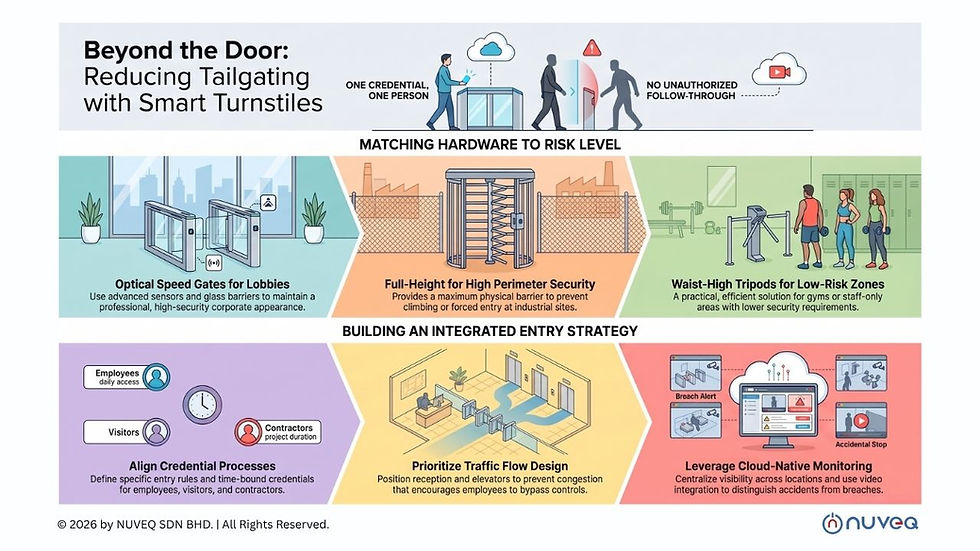
Why turnstiles change the tailgating equation
Traditional access-controlled doors confirm that a credential was presented. They do not necessarily confirm how many people passed through. A turnstile introduces a defined passage lane and a physical sequence: present credential, receive authorization, pass through, and allow the lane to reset before the next person enters.
That sequence creates accountability. When integrated with access control software, every valid entry can be associated with a card, mobile credential, biometric match, or verified digital identity. The system can also identify forced passage attempts, extended lane openings, wrong-way movement, or other events that deserve review.
Turnstiles are especially effective at entrances where the risk and foot traffic justify a more deliberate control point. This may include corporate headquarters, shared office buildings, university facilities, fitness centers, industrial sites, government offices, and high-value operations areas. They are not automatically the best answer for every opening. A small staff-only office with low traffic may benefit more from a properly configured door reader and policy enforcement, while a busy public lobby may need turnstiles plus reception, visitor management, and video verification.
Choose the right turnstile for the risk
The most effective way to reduce tailgating with turnstiles is to match the equipment to the environment. A turnstile that is too restrictive will create queues and encourage staff to bypass the intended entrance. One that is too open may deliver little more than a visual deterrent.
Waist-high tripod turnstiles
Tripod models are a practical option for controlled staff entrances, gyms, and lower-risk areas. They clearly signal that each person needs authorization and can process regular traffic efficiently. However, they may not be appropriate where accessibility requirements, luggage, deliveries, or a higher level of intrusion resistance are central concerns. An accessible gate should be planned alongside them, not treated as an afterthought.
Optical speed gates
Optical turnstiles use glass or acrylic barriers, sensors, and controlled lanes to manage entry in corporate lobbies and premium commercial environments. Their sensors can detect direction and passage behavior while maintaining an open, professional appearance. They are well suited to facilities that need stronger identity control without making the entry experience feel like a checkpoint.
The quality of detection matters. Sensor coverage, lane width, barrier height, and the control logic determine whether the equipment can identify close-following attempts. A basic optical lane may deter casual tailgating, while a higher-security configuration with advanced detection and alarms is better for sensitive facilities.
Full-height turnstiles
For exterior perimeters, industrial operations, construction sites, and unattended access points, full-height turnstiles provide a more physical barrier. They limit climbing and pass-through attempts more effectively than lobby-style lanes. The trade-off is lower throughput and a more fortified visual presence, which may not suit customer-facing entrances.
No matter which style is selected, emergency egress and local fire and life-safety requirements must guide the design. Security controls should never obstruct a safe exit during an emergency.
Build an entry process, not just a barrier
A turnstile operates best when it is part of a connected access strategy. Start by defining who enters each lane, what credential they use, and what should happen when authorization is denied or an anomaly is detected.
Employees may use mobile credentials or encrypted access cards. Higher-risk areas can add biometric verification, requiring the credential holder to prove identity rather than simply present a transferable card. Visitors should be registered through a visitor management process, issued time-bound credentials, and directed through a supervised lane. Contractors may need credentials restricted by date, site, shift, or approved zones.
This approach removes ambiguity at the entrance. It also gives facilities and security teams a cleaner record of who was expected on site and when. If a security event occurs, investigators can compare access events with video, visitor records, and alarm activity instead of relying on incomplete sign-in sheets or assumptions.
Design the space around real traffic patterns
Tailgating prevention begins before anyone reaches the reader. People tend to follow others when an entry point is congested, poorly marked, or inconvenient. Separate inbound and outbound flows, provide enough lanes for peak arrival times, and make the credential presentation point obvious.
Reception desks, elevators, and visitor check-in stations should be positioned so people do not gather in front of the turnstile lanes. When lanes are blocked, employees may prop doors open or look for alternate paths. The goal is controlled movement that feels efficient, not an obstacle course.
For multi-tenant properties, consider whether each tenant needs separate access rules or whether the building requires a common lobby credential followed by tenant-level controls. A centralized platform can apply different permissions across sites and suites without requiring separate, disconnected systems.
Use cloud monitoring to turn events into action
A turnstile alarm is useful only if someone can see it, investigate it, and respond according to policy. Cloud-based access control gives security and facilities teams remote visibility into entry events across locations. Instead of relying on an on-site server or manually collecting logs from each building, authorized teams can monitor activity from a centralized interface.
Configure alerts for repeated invalid credentials, forced-open conditions, tailgating sensor events, and unusual after-hours access. Alerts should be meaningful. If every minor event triggers the same escalation, teams may begin to ignore notifications. Define which events require a real-time response, which should create a case for review, and which can be summarized in periodic reports.
Video integration adds context. An access event may show that an employee accidentally allowed a colleague through during a rush, while another event may show deliberate unauthorized entry. The difference affects the response. Security teams can coach employees on the first issue and investigate the second with evidence.
NUVEQ supports this kind of connected approach by bringing cloud-native access control, visitor management, video, identity verification, and turnstile integrations into one scalable security ecosystem. For organizations managing multiple locations, centralized administration can reduce the operational burden of maintaining different credential rules, hardware settings, and event records at every site.
Pair technology with a clear human policy
Even well-designed turnstiles cannot replace security awareness. Employees need simple guidance: do not allow unknown individuals through an authorized lane, direct visitors to check-in, report suspicious behavior, and avoid confronting a person when doing so could create a safety risk.
The policy should distinguish between accidental courtesy and intentional circumvention. Treating every tailgating event as misconduct can discourage reporting. Treating every event casually can normalize poor behavior. A measured approach uses training for first-time, low-risk incidents and stronger investigation when behavior is repeated, deliberate, or connected to restricted areas.
Security officers and reception staff also need a defined response. They should know how to assist someone whose credential fails, how to verify an expected visitor, and when to escalate an attempted bypass. This reduces the temptation to override controls simply to keep a line moving.
Measure results and refine the configuration
After deployment, review entry data rather than assuming the project is complete. Compare tailgating alarms, denied access events, visitor volumes, lane throughput, and peak-time queues over several weeks. This reveals whether the issue is a security violation, a workflow problem, or both.
If alarms cluster at 8:30 a.m., adding a lane or adjusting arrival policies may solve the problem better than increasing alarm sensitivity. If a particular department produces repeated exceptions, targeted coaching may be more effective than a building-wide campaign. If one location has persistent after-hours attempts, the organization may need stronger credentials, video coverage, or a different turnstile type.
The best turnstile program makes authorized entry easy to follow and unauthorized entry difficult to hide. When identity verification, physical lane control, cloud monitoring, and practical policies work together, the entrance becomes an active part of the security strategy rather than a passive doorway.


Comments