


Turnstiles vs Barrier Gates: Understanding the Differences

Updated: 6 days ago
Turnstiles are pedestrian access devices. They create a defined passage point and allow one authorized person through at a time, depending on the model and configuration. Common options include tripod turnstiles, waist-high swing gates, full-height turnstiles, and optical speed gates. Each serves a different balance of throughput, deterrence, accessibility, and design.
Barrier gates, often called vehicle barriers or boom gates, are designed for cars, trucks, and other vehicles. A rising arm blocks or permits traffic at parking garages, private campuses, gated communities, logistics sites, and secured perimeters. They can operate through RFID tags, mobile credentials, license plate recognition, keypads, intercoms, or staffed guard workflows.
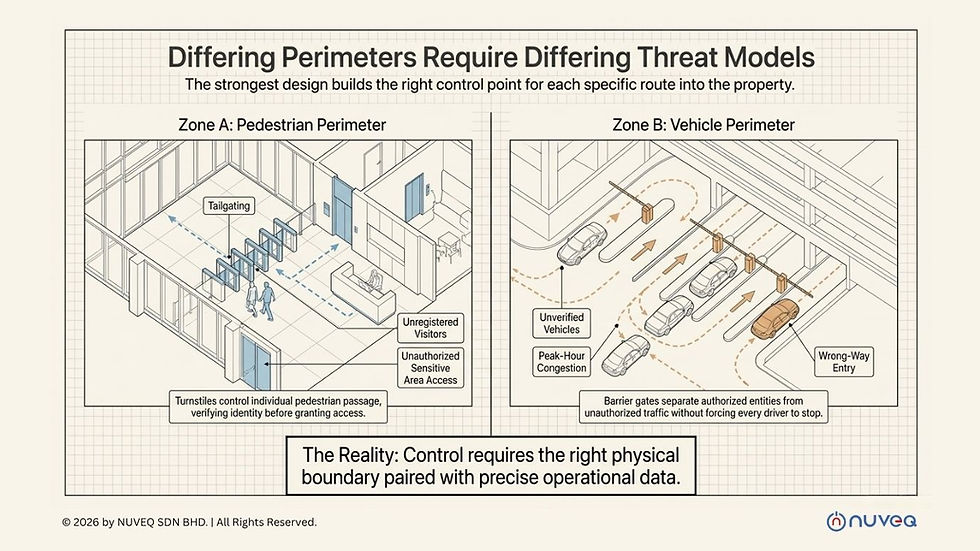
The distinction matters because the threat models are different. At a pedestrian entrance, the concern may be tailgating, unregistered visitors, and unauthorized movement into sensitive areas. At a vehicle entrance, the concern may be unverified vehicles, congestion at peak hours, wrong-way entry, or the need to maintain a reliable record of site access.
The Importance of Choosing the Right System
A facility with both public-facing reception and controlled parking generally needs both categories. The stronger design is not choosing one device for every problem. It is building the right control point for each route into the property.
When Turnstiles Are the Better Choice
Turnstiles are most effective where a facility needs to verify each pedestrian before granting access. That makes them well suited to corporate offices, fitness centers, higher education buildings, hospitals, data centers, government facilities, and residential amenity areas.
A secured lobby is a common example. A card reader installed beside an unlocked glass door records a credential event, but it does not necessarily stop a second person from following closely behind. A turnstile introduces a physical boundary. When integrated with access control, the device can release only after a valid credential, biometric verification, mobile pass, or approved visitor credential is presented.
The right model depends on the security objective. Optical speed gates support a polished tenant or visitor experience and can pair well with reception staff, video verification, and anti-tailgating alerts. Tripod turnstiles offer a compact, economical option for staff entrances and gyms. Full-height turnstiles provide a much stronger perimeter-control measure for industrial sites, outdoor facilities, and areas where an employee cannot simply walk around the device.
Accessibility must be designed into the deployment. Many sites pair standard turnstiles with a wider ADA-compliant gate that can be activated by an authorized credential or supervised remotely. Fire and life-safety requirements also influence configuration. Devices may need to unlock, open, or permit free passage during a designated emergency condition, subject to local code and the facility's approved life-safety plan.
Turnstiles are not automatically the best choice for every lobby. A small office with low traffic and a consistently staffed reception desk may gain more from visitor management and a controlled door. Conversely, a high-traffic site without enough lane capacity can create queues that frustrate users and encourage people to bypass the intended process.
When Barrier Gates Are the Better Choice
Barrier gates are the practical choice when vehicles need controlled access to a property. They establish a visible control point without forcing every driver to stop for a guard, which makes them valuable for multi-tenant garages, employee lots, gated residential communities, distribution centers, and private campuses.
For a commercial property, the goal is often to separate authorized tenants, employees, contractors, and visitors from unauthorized vehicles while preserving efficient entry during busy periods. A barrier gate connected to cloud-based access control can recognize an approved credential and open automatically. When paired with ANPR, the system can use a vehicle's license plate as an additional identifier or as the primary credential for approved vehicles.
At logistics and industrial locations, the use case becomes more demanding. A gate may need to distinguish employee vehicles from scheduled deliveries, trigger specific routes for trucks, log entry and exit times, and alert operators when a vehicle is denied. Long-arm barriers, loop detectors, safety photocells, and carefully positioned signage are all part of the deployment, not optional afterthoughts.
Vehicle barriers also require stronger attention to safety and site geometry than many buyers expect. Arm length, opening speed, lane width, vehicle turning radius, drainage, bollards, and emergency access all affect performance. A barrier that is technically capable but installed in the wrong location can create a bottleneck or expose vehicles and pedestrians to avoidable risk.
Compare Security, Throughput, and User Experience
The most useful comparison is not which device is more secure in the abstract. It is whether the device gives the site enough control without creating unnecessary friction.
A full-height turnstile offers a higher physical deterrent against pedestrian intrusion than an optical lane, but it is slower and less appropriate for a premium office entrance. An optical turnstile can handle higher volumes and support an open architectural aesthetic, but it works best when combined with credential validation, camera coverage, clear visitor procedures, and active response to alarms.
Similarly, a barrier gate can prevent casual vehicle entry, but it is not a complete perimeter solution on its own. Vehicles may still be able to follow another car through a raised arm if the lane lacks detection logic and monitoring. High-security vehicle entrances can require anti-tailgating controls, second gates, wedges, bollards, guard validation, or vehicle inspection processes depending on the risk profile.
Throughput should be calculated around real peak conditions, not average daily use. Consider the 15 minutes before an office shift begins, a school dismissal window, a concert arrival period, or the morning rush into a parking structure. The system needs enough lanes, opening speed, and credential-read reliability to keep authorized users moving while maintaining accountability.
Build Both Into One Access Strategy
The strongest facilities treat turnstiles and barrier gates as connected endpoints in a broader identity and access strategy. An employee might use a mobile credential to enter the garage, pass through a lobby speed gate, access a restricted floor via elevator controls, and enter a secure room with a biometric check. Each event can be managed through one centralized policy rather than disconnected systems.
Cloud-native access control makes this model more practical across multiple locations. Security teams can issue or revoke credentials remotely, view device status, adjust schedules, review events, and troubleshoot without depending on an on-premise server at each building. It also reduces the administrative burden of managing separate systems for parking, visitor entry, doors, and restricted zones.
Integration is especially valuable when access rules change quickly. A contractor approved for a single work order may need vehicle access during a specific window, pedestrian access only to designated areas, and no access after the job is complete. A unified platform can apply those rules consistently, instead of leaving staff to coordinate gate remotes, temporary cards, paper sign-in sheets, and manual follow-up.
NUVEQ supports this approach by connecting cloud-based access control with visitor management, mobile credentials, biometrics, ANPR, video, elevator control, turnstiles, and barrier gates. The outcome is more than a collection of devices. It is a clearer operating picture of who entered, where they went, and whether the system responded as intended.
Questions to Ask Before You Specify Equipment
Before selecting a device, define the access route and the consequence of a failure. Ask whether you are controlling people, vehicles, or both; how many users arrive during peak periods; what type of credential they will use; and what happens if a person tailgates or a vehicle forces entry.
Also assess operational ownership. Reception teams may manage visitor enrollment, facilities may handle equipment maintenance, IT may oversee network policies, and security may own incident response. The selected system should give each group the right level of access without creating fragmented administration.
Finally, plan for growth. A one-lane barrier at a single property or two speed gates in a lobby may meet today's requirement, but the platform should support additional lanes, sites, readers, cameras, and credential types without a costly system replacement. Open integrations and centralized cloud administration are strategic advantages when the portfolio expands.
The best next step is a site-specific access assessment: map every pedestrian and vehicle route, identify where identity verification must occur, and design each control point around actual risk and traffic. That gives your organization a system that protects the property without making everyday movement harder than it needs to be.
Conclusion
In conclusion, understanding the differences between turnstiles and barrier gates is essential for creating a secure environment. By carefully assessing your needs and the specific context of your facility, you can make informed decisions that enhance security while ensuring smooth operations. Whether you choose turnstiles, barrier gates, or a combination of both, the goal remains the same: to protect your organization effectively while facilitating easy access for authorized individuals.


Comments