


10 Best Cloud Security Platforms

If your team is still managing security site by site, server by server, the problem is no longer just complexity. It is visibility. The best cloud security platforms give security leaders, facilities teams, and IT stakeholders a single operating layer for access, identity, video, alarms, and remote administration across every location they oversee.
That matters most in organizations with multiple buildings, mixed user groups, and growing compliance pressure. A disconnected stack might still function, but it rarely scales cleanly. Credential changes take too long, reporting is fragmented, and on-premise infrastructure becomes one more system to maintain, patch, and eventually replace.

What makes the best cloud security platforms worth buying
Not every cloud-based system deserves a spot on a shortlist. Some platforms simply move a legacy product into a hosted environment without fixing the operational issues that made the old model expensive and rigid in the first place.
The best cloud security platforms reduce hardware dependence, centralize administration, and support real-world workflows. That includes onboarding employees, managing visitors, securing restricted areas, reviewing events, and responding to incidents without requiring staff to be physically present at each site.
For enterprise and institutional buyers, the real test is not whether a platform has a cloud dashboard. It is whether that platform can support thousands of identities, multiple facility types, and integration across physical security layers without creating new silos.
How to evaluate best cloud security platforms for your environment
A good evaluation starts with architecture, not just features. Buyers often focus on door counts, camera counts, or mobile credentials first. Those matter, but the bigger question is how the platform behaves over time.
A cloud-native system should make expansion easier. You should be able to add sites without standing up more local servers, pushing more manual updates, or creating another admin environment. If your team is planning for growth, acquisitions, tenant turnover, or portfolio-wide standardization, this point carries more weight than a long feature checklist.
Security teams should also look closely at identity management. Access decisions are stronger when credentials, visitor workflows, biometric factors, and verification tools work together. A platform that handles only door control may solve one issue while leaving reception, deliveries, contractor access, and after-hours exceptions to separate systems.
Integration is another dividing line. Open APIs, support for third-party devices, and compatibility with broader building systems can make the difference between a future-ready investment and a closed ecosystem that becomes harder to justify every year.
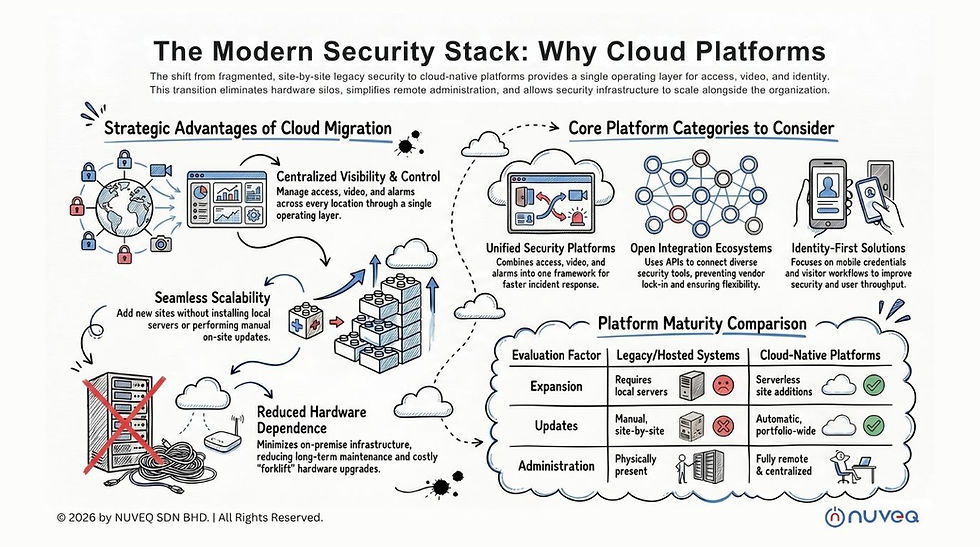
10 best cloud security platforms to consider
1. Cloud-native access control platforms
For many organizations, access control remains the foundation. The strongest cloud-native access control platforms centralize door management, user permissions, schedules, audit trails, and emergency lockdown workflows in one interface. They are especially valuable for commercial real estate, enterprise offices, healthcare sites, educational campuses, and distributed portfolios where remote administration saves time every day.
The advantage here is control at scale. Admins can issue or revoke credentials immediately, adjust permissions across multiple facilities, and troubleshoot without dispatching staff on site. The trade-off is that not every platform handles complex hardware environments equally well, so migration planning matters.
2. Unified physical security platforms
These platforms combine access control, video, alarms, intercoms, visitor flows, and event monitoring under a single cloud framework. For buyers dealing with fragmented systems, this model often delivers the biggest operational gain because it reduces the number of dashboards, vendors, and disconnected event logs.
Unified platforms are a strong fit when incident response depends on correlation. If a door event, credential anomaly, and camera clip need to be reviewed together, a unified environment helps teams move faster. The trade-off is implementation scope. Broader systems can require more planning upfront, but they usually create better long-term efficiency.
3. Cloud video surveillance platforms
Video as a service has become a practical option for organizations that want remote visibility without maintaining traditional recorder infrastructure at every site. The better platforms support centralized monitoring, retention management, intelligent search, and secure sharing of footage for investigations.
For operators managing retail locations, residential properties, parking environments, or logistics sites, cloud video can reduce maintenance overhead significantly. Bandwidth, retention costs, and camera compatibility should still be reviewed carefully, especially in high-volume environments.
4. Visitor management and identity verification platforms
A surprising number of facilities still run visitor access through spreadsheets, paper logs, or disconnected front desk tools. Cloud-based visitor and identity platforms improve both security and throughput. They pre-screen visitors, verify identity, issue temporary credentials, and maintain clear records for compliance and investigations.
These systems are especially effective in workplaces with contractors, regulated access zones, shared buildings, and high daily traffic. The strongest options integrate with access control so visitor approval does not stop at check-in.
5. Mobile credential and digital identity platforms
Mobile-first platforms replace plastic cards with smartphone-based credentials, often paired with multifactor verification or digital identity services. They reduce reissuance costs and streamline user experience, especially for workplaces with frequent staff changes, flexible schedules, and limited front desk staffing.
The main benefit is agility. Credentials can be issued remotely, revoked instantly, and tied to policy updates without a physical handoff. That said, organizations with diverse device policies or higher-assurance requirements may still need hybrid credential strategies.
6. Biometric security platforms
Biometrics have moved well beyond niche deployments. Cloud-managed biometric platforms support stronger authentication for sensitive spaces such as data centers, labs, financial institutions, and critical infrastructure. They also help reduce credential sharing and improve certainty around who actually entered a controlled space.
This category requires careful policy review. Privacy expectations, local regulations, and user acceptance can affect rollout. Biometrics are powerful, but they work best when paired with clear governance and justified use cases.
7. ANPR and vehicle access platforms
For facilities where vehicle flow matters as much as pedestrian entry, cloud-based automatic number plate recognition platforms add speed and control. They support gated communities, logistics yards, corporate campuses, parking assets, and industrial facilities where manual vehicle processing creates delays or weak points.
The right platform should connect license plate events with broader access rules and reporting. A standalone vehicle tool may help operations, but an integrated one improves security posture.
8. Smart IoT controller platforms
Cloud-managed controllers are often overlooked during evaluation, but they shape scalability more than buyers expect. Modern IoT security controllers reduce dependence on bulky server infrastructure and support distributed deployments that are easier to maintain across many sites.
This matters for organizations modernizing from legacy hardware. A platform may have impressive software, but if the controller layer is difficult to update or integrate, the system can become harder to support as the footprint grows.
9. Cloud alarm and incident management platforms
These platforms focus on detection, escalation, and response workflows. They help teams verify events, route alerts, document actions, and maintain consistent procedures across locations. In practice, they are most useful when security operations span multiple properties and after-hours staffing is limited.
Buyers should look for platforms that connect alarms with access and video data rather than treating them as separate streams. Faster response usually depends on context, not just notification speed.
10. Open integration security ecosystems
Some of the best cloud security platforms are not defined by one module. They stand out because they create an open ecosystem where access control, visitor management, mobile credentials, biometrics, video, and building technologies can operate together through APIs and shared workflows.
For enterprise buyers, this is often the smartest long-term path. It protects flexibility, supports phased rollouts, and reduces the risk of getting locked into a platform that cannot adapt to new requirements. A provider such as NUVEQ fits this model by combining cloud-native access control with connected physical security tools under one scalable operating environment.
The trade-offs buyers should not ignore
Cloud adoption improves a lot, but it does not remove every decision. Some environments still need edge resiliency, local failover behavior, and hardware validation before a full rollout. Healthcare, banking, industrial sites, and government-related facilities often have more complex policies than standard office deployments.
There is also a difference between platforms built for small businesses and platforms ready for enterprise administration. A system may look clean in a demo and still fall short on partitioning, audit depth, integrations, custom roles, or large-scale credential lifecycle management.
Cost should be examined beyond the subscription line. A lower monthly fee may come with limited support for hardware reuse, thin reporting, or expensive add-ons for video, identity, or API access. A higher-priced platform may reduce labor, server replacement, site visits, and training complexity enough to justify the difference.
Which type of platform is usually the best fit?
It depends on the problem you are trying to solve.
If your biggest issue is fragmented door control, start with cloud-native access control. If investigations are slowed down because video, alarms, and access logs live in separate systems, unified physical security platforms usually create more value. If your organization manages high visitor volume, sensitive spaces, or recurring contractor access, identity-centered platforms deserve more attention than they often get.
For multi-site operators, the strongest choice is usually the platform that centralizes administration while leaving room to expand into adjacent functions. Security infrastructure should not force another forklift upgrade every few years. It should support growth, policy change, and new integrations without pulling operations backward.
The market for the best cloud security platforms is maturing quickly, but the winning criteria are staying consistent. Buyers want fewer silos, less hardware overhead, stronger identity assurance, and clearer control across every site they manage. The right platform does more than move security into the cloud. It gives your team a better way to run the business behind the doors.


Comments